

For a fresher, a resume is not just a document. It is your first professional identity.
Before any interview.
Before any phone call.
Before anyone knows your personality.
Your resume decides whether you even get a chance.
Yet most freshers still build resumes like college assignments — marks, subjects, and generic lines copied from the internet. Recruiters don’t reject these resumes because students are weak. They reject them because the resume does not show readiness for the real world.
If you are a fresher in 2026, your resume must show only one thing clearly:
“This candidate can learn fast and already knows how to apply skills in practice.”
This guide explains how freshers should actually build a resume — based on what companies now expect.
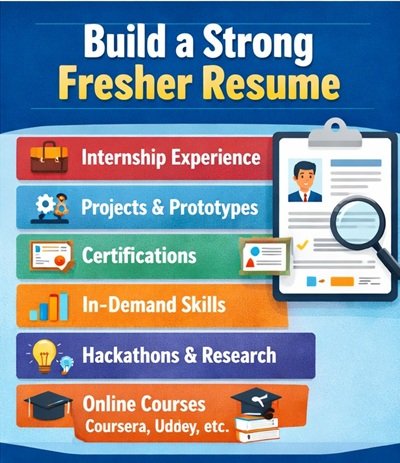
Stop Thinking of Your Resume as a Marks Document
Your degree is important.
But your resume should never look like a marksheet.
Recruiters already assume you studied your subject. What they want to see is:
- Have you applied anything?
- Have you worked in any real environment?
- Have you built, tested, analyzed, or created something?
A strong fresher resume is not about what you studied.
It is about what you have done.
Internships Are No Longer Optional
One of the biggest differences between selected and rejected freshers today is internship exposure.
Internships show recruiters that you:
- Understand workplace discipline
- Can work under real deadlines
- Have seen real problems, not only textbook ones
Your resume should clearly mention:
- Corporate internships
- Government or PSU internships
- Startup internships
- Virtual or remote internships
- Multi-sector internships
Even short internships matter.
If you are still in college, you are already late if your resume has zero internships.
Platforms like Internshala, LinkedIn, company career pages, and Apuzz internship updates are very useful to get early opportunities. The goal is not salary. The goal is experience.
Projects Are the Real Resume for Freshers
A fresher resume without projects is like a shop without products.
Every fresher should have:
- At least 2 solid projects
- Clearly explained
- With tools and outcomes
Good examples include:
- AI or machine learning models
- Data analysis dashboards
- Automation tools
- Websites or applications
- Finance or business analysis projects
Your project section should answer:
- What problem did you solve?
- What tools did you use?
- What was the result?
If possible, add:
- GitHub links
- Portfolio website
- Live demos
Projects prove ability. Degrees only prove attendance.
Research Work, Papers, and Hackathons Matter
Many students ignore these, which is a big mistake.
If you have:
- Published a paper
- Worked on research
- Participated in hackathons
- Built solutions in competitions
They must be on your resume.
These show initiative, innovation, teamwork, and curiosity — qualities companies value highly in freshers.
Even if you did not win, participation itself shows seriousness.
Learn What the Market Needs, Not Only What Colleges Teach
A modern fresher resume must reflect current industry trends.
In 2026, recruiters actively look for exposure in areas such as:
- Artificial Intelligence and Machine Learning
- Data Engineering and Analytics
- Cloud platforms
- Cybersecurity
- Automation and DevOps
- Business Intelligence
Your resume should show hands-on work with tools like:
- Python, SQL
- Power BI, Tableau
- Alteryx
- Splunk
- Cloud platforms
- Open-source tools
Do not write long skill lists.
Write what you can actually use.
Certifications Support a Fresher Resume (If Chosen Correctly)
Certifications alone won’t give jobs.
But for freshers, they strongly support credibility.
They show:
- Structured learning
- Discipline
- Updated knowledge
Good platforms include:
Tool-specific certifications help a lot, such as:
- Power BI
- Tableau
- Alteryx
- Splunk
- Cloud fundamentals
- Cybersecurity basics
Especially in the early phase, certifications help your resume pass shortlisting.
Your Degree Doesn’t Limit Your Career
Many freshers wrongly believe only engineers get IT jobs.
Today, companies hire IT and analytics freshers from:
- Engineering
- BSc / BCA
- BCom / BBA
- BA
- Finance backgrounds
What matters is not your degree name.
What matters is how your resume is built.
If you want an IT job, your resume must look like an IT resume:
- Tools
- Projects
- Certifications
- Practical exposure
Not a general graduation summary.
Show That You Are a Learner, Not Just a Graduate
Companies do not expect freshers to know everything.
They look for:
- Learning mindset
- Curiosity
- Adaptability
Your resume should reflect this through:
- Online courses
- Self-built projects
- Hackathons
- Workshops
- Open-source contributions
A resume that shows continuous learning always stands out.
Keep It Honest, Practical, and Clean
A strong fresher resume is:
- 1 page (or max 2)
- Clear and simple
- Error-free
- Honest
Avoid:
- Fake skills
- Overloaded formats
- Copied content
- Long theory paragraphs
One real project is better than ten fake technologies.

What a Strong Fresher Resume Should Contain in 2026
At minimum:
- Internship experience
- Practical projects
- Market-relevant tools
- 2–3 good certifications
- Clear career direction
- Proof of learning mindset
If your resume doesn’t yet have these, don’t panic.
That only means your current phase is resume building, not mass job applying.
Apuzz Career Advice
Freshers who start early with internships, live projects, and skill development always perform better in off-campus drives and placements.
If you are still studying or recently graduated, regularly check the Internship and Off Campus sections on Apuzz.com.
The right exposure at the right time can completely change your career direction.